
Navagraha and Their Grains: A Guide to Nine Deities, Seed Offerings and Cooking at Home

In many Hindu homes, a small bowl of grain can carry a large meaning. Navadhanya, or the nine grains, are traditionally associated with the Navagraha—the nine celestial deities honoured in Hindu religious practice and astrology. Families may place these grains before a shrine, offer them during a puja, or donate food as an expression of gratitude and generosity.
If you are looking for a practical Navagraha grains list, this guide introduces each deity, a commonly used offering and a simple way to cook the corresponding ingredient. A husband can certainly prepare the grains and help with the puja; so can a wife, partner or other family member. Follow your own household or temple customs, and take pleasure in sharing the work.
A note on traditions: There is no single universally accepted list. The pairings below follow one commonly published version; regional and family practices differ, particularly for Mars and Venus. For a formal ceremony, check the list with your priest or temple before shopping. This Navagraha puja guide lists the same nine pairings used here, while this overview of Navadhanya describes another version and regional alternatives.
What are the Navagraha?
The word nava means nine, and graha refers to a celestial influence. The Navagraha comprise Surya, Chandra, Mangala, Budha, Guru, Shukra and Shani, as well as Rahu and Ketu. The last two are traditionally called shadow grahas; astronomically they correspond to the ascending and descending lunar nodes, not physical planets. See Britannica’s introduction to the Navagraha for an accessible overview.
In devotional and astrological traditions, each graha has symbolic associations. People may honour them during a Navagraha puja, a housewarming or a personal prayer. These associations are matters of religious belief, not scientifically established effects of offerings on health, luck or planetary influence.
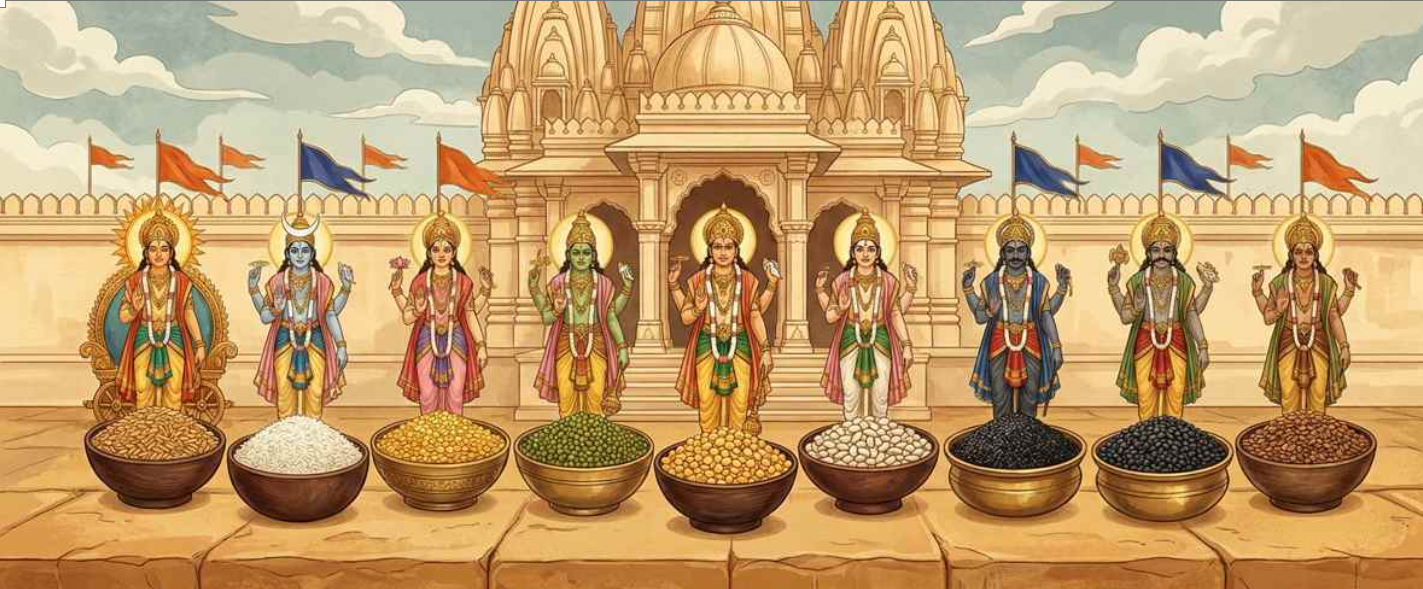
Image note: The deity and grain images are AI-generated illustrations, not identification guides. Check product labels and your temple’s list before buying; the exact appearance and variety may differ.
Navagraha grains list at a glance
| Deity | Celestial association | Grain or seed in this guide | Common day |
| Surya | Sun | Whole wheat | Sunday |
| Chandra | Moon | Rice or paddy | Monday |
| Mangala / Mangal | Mars | Toor dal, also called red gram or pigeon pea | Tuesday |
| Budha / Budh | Mercury | Whole green moong, or mung beans | Wednesday |
| Guru / Brihaspati | Jupiter | Chana dal, or split Bengal gram | Thursday |
| Shukra | Venus | White beans, such as mochai | Friday |
| Shani | Saturn | Black sesame seeds, or black til | Saturday |
| Rahu | Ascending lunar node | Whole black urad, or black gram | Varies by tradition |
| Ketu | Descending lunar node | Horse gram, or kulthi / kollu | Varies by tradition |
Although commonly called “nine grains” or “nine seeds,” the selection includes cereals, pulses and sesame seeds. Ingredient names can be confusing: red gram is pigeon pea, not red lentils; split toor dal is often yellow. Black gram is urad, not ordinary black lentils. Chana dal is split Bengal gram, a type of chickpea. Ask a knowledgeable seller if a label is unclear.
Why are grains offered to the Navagraha?
Grain is nourishing, storable and familiar to households across India and the wider diaspora. In a puja, offering a small amount can express respect, gratitude for food and a wish to live with awareness. Many worshippers understand each grain’s colour, character or customary association as a way of remembering a particular graha.
Some devotees make offerings with a prayer for shanti, or peace. Others emphasise charity: giving food to people who need it turns devotion into an act of care. Meanings vary, and not every family offers the grains in the same way. The symbolism below is an accessible devotional interpretation, not a claim that a particular colour or ingredient has one fixed meaning across all traditions.
Use clean food, avoid waste and never feel obliged to buy expensive ritual supplies.
1. Surya: wheat for the Sun


Grain illustration: Whole wheat berries for Surya.
Offering: Whole wheat Traditional day: Sunday
Surya, the Sun deity, is often associated with light, vitality and the rhythm of daily life. In this Navagraha grain list, whole wheat is offered to Surya. Its golden colour and role as a staple can remind a family of nourishment and the energy of the sun that supports crops.
Place a small spoonful of clean wheat berries in a separate bowl before an image of Surya or a Navagraha picture. You might say a simple prayer of gratitude for daylight, food and the people who grow it.
Husband-can-cook idea: Soak food-grade wheat berries, then simmer in fresh water until tender according to the packet. Add vegetables and herbs for a warm grain salad. Wheat contains gluten, so choose an appropriate alternative for anyone with coeliac disease or a wheat allergy; a substitution for a ritual should be checked with the family or priest.
2. Chandra: rice for the Moon


Grain illustration: Uncooked white rice for Chandra.
Offering: Raw rice or paddy Traditional day: Monday
Chandra, also known as Soma, represents the Moon. Devotees often connect Chandra with calmness, reflection and emotional life. White rice is a familiar offering in this tradition; some families use paddy, meaning rice still in its husk.
Set aside a spoonful of clean rice in a small dish. As you place it near the shrine, you may reflect on patience, rest and the care you give to others. Keep the rice dry, and ask your temple before bringing loose grains into a shared worship space.
Husband-can-cook idea: Rinse food-grade rice if the packet recommends it and cook following the instructions. Serve with vegetables or dal. If making rice ahead, cool it promptly, refrigerate and reheat thoroughly; cooked rice should not sit at room temperature for long. Unhusked paddy is not ready-to-cook rice, so use a suitable edible product for the meal.
3. Mangala: toor dal for Mars husband can cook


Grain illustration: Yellow split pigeon peas or toor dal for Mangala.
Offering: Toor dal, also called pigeon pea or red gram Traditional day: Tuesday
Mangala, Mangal or Kuja is the graha associated with Mars. In devotional descriptions, Mars is often linked with courage, action and strength. In the list used here, the offering is toor dal. Other published lists use chickpeas or other pulses, so check the preferred ingredient before arranging a formal Navagraha puja.
Offer a small portion of dry dal in its own bowl. The word “red” in red gram refers to the pulse’s common name; the split dal in shops is typically yellow.
Husband-can-cook idea: Wash the dal and simmer it thoroughly in water until soft, following the packet. Stir in cooked tomatoes, cumin and a little turmeric for a simple meal. Serve with rice. Avoid assuming split toor dal and red masoor dal are interchangeable in a prescribed ritual.
4. Budha: green moong for Mercury – Husbandcancook


Grain illustration: Whole green mung beans for Budha.
Offering: Whole green moong, or mung beans Traditional day: Wednesday
Budha is associated with Mercury and is often connected with learning, communication and thoughtful decision-making. Green moong is a common offering. Its green colour can serve as a gentle reminder of growth and learning, though the meaning a family attaches to it may differ.
Place a spoonful of whole green mung beans before the chosen image. A simple household prayer might ask for clarity of speech and kindness in listening.
Husband-can-cook idea: Wash and soak the beans if recommended, then simmer until fully tender. Add ginger and vegetables to make a comforting moong curry. Do not assume that raw home-grown sprouts are safe for everyone; thoroughly cooking beans is the simpler choice for a family meal.
5. Guru: chana dal for Jupiter


Grain illustration: Yellow split Bengal gram or chana dal for Guru.
Offering: Chana dal, or split Bengal gram Traditional day: Thursday
Guru, also called Brihaspati, is associated with Jupiter. Traditionally honoured as a teacher, Guru is connected with wisdom, learning and guidance. Yellow chana dal is a common ingredient in this version of the nine-grain list.
Place a little chana dal in a clean bowl. A donation of food or practical help can be a meaningful companion to the offering.
Husband-can-cook idea: Rinse the chana dal, soak if the packet advises and cook until fully tender. Season with cumin, ginger and tomatoes. Chana dal is not the same as toor dal even though both may look yellow when split, so label the bowls before the puja.
6. Shukra: white beans for Venus


Grain illustration: Dried white beans for Shukra; exact variety varies by tradition.
Offering: White beans, such as mochai where specified Traditional day: Friday
Shukra is the graha associated with Venus and is often linked with beauty, relationships and appreciation. In the list used here, white beans are offered to Shukra. The exact bean varies by region: a temple may ask specifically for mochai or another local variety. “White beans” is a broad shop label, not a guarantee that a packet matches every ritual tradition.
Set out a small amount of the bean specified by your household. Consider a prayer for harmony and gratitude within the family.
Husband-can-cook idea: Buy edible beans, identify the variety and follow its soaking and cooking directions exactly. Never eat undercooked dried beans. Some, especially kidney beans, require specific vigorous boiling for safety; a slow cooker alone may not reach a safe temperature. If the bean is unidentified, do not cook it until you know how to prepare it safely.
7. Shani: black sesame for Saturn


Grain illustration: Black sesame seeds for Shani.
Offering: Black sesame seeds, or black til Traditional day: Saturday
Shani is associated with Saturn and is often described in relation to discipline, responsibility and perseverance. Black sesame is a widely listed offering. For some devotees, Shani worship is a reminder to act fairly and patiently, especially when life feels demanding.
Put a small spoonful of clean black sesame in a dish. If visiting a temple, ask whether it accepts loose sesame or prefers a packaged donation.
Husband-can-cook idea: Toast a small quantity of food-grade sesame in a dry pan over gentle heat, watching closely so it does not burn. Sprinkle over cooked vegetables or rice. Sesame is a recognised allergen, so check before serving it or sharing food with others.
8. Rahu: black urad for the ascending lunar node


Grain illustration: Whole black urad beans for Rahu.
Offering: Whole black urad, also called black gram Traditional day: No single universal weekday
Rahu represents the ascending lunar node and is personified as a shadow graha in Hindu tradition. Interpretations differ; devotees may reflect on uncertainty, desire or the need for discernment. Rahu is not a physical planet, and religious symbolism should not be confused with an astronomical explanation of eclipses.
Place whole black urad in a separate bowl. A simple prayer can focus on making wise choices and treating others thoughtfully rather than fear of an unfavourable outcome.
Husband-can-cook idea: Wash and soak whole urad as directed, then cook until completely tender. Add tomato, ginger and mild spices for an urad dal. Whole black urad retains a dark skin, whereas split and skinned urad looks different; check which form your ritual requires.
9. Ketu: horse gram for the descending lunar node


Grain illustration: Brown horse gram for Ketu.
Offering: Horse gram, also called kulthi or kollu Traditional day: No single universal weekday
Ketu represents the descending lunar node and is another shadow graha. In devotional interpretations, Ketu may be associated with reflection, detachment or spiritual inquiry. Horse gram is the offering used in this guide and in several published Navadhanya lists.
Set a spoonful in a clean dish beside the other offerings. As with Rahu, an appropriate time or ritual may vary considerably between households.
Husband-can-cook idea: Sort and wash food-grade horse gram, soak it as instructed and cook until tender. Use it in a warming soup with garlic and vegetables. Cooking times vary, especially with older dried beans; add enough water and follow the packet or a reliable recipe.
How to offer Navagraha grains at home
This simple method is a general home practice, not a replacement for a priest-led Navagraha shanti puja. If your family follows a particular sampradaya or temple procedure, that guidance comes first.
- Gather the ingredients. Use the table above or the list supplied by your priest. A spoonful of each grain is sufficient for this informal example. Keep the remainder sealed for cooking or donation.
- Prepare the space. Clean a table or prayer area and place a Navagraha image, if you have one. Set out nine clean bowls or a tray with nine separate portions. Labels can help prevent mix-ups.
- Take a moment to pray. You may bathe or wash your hands first, according to household custom. State your intention in your own words: gratitude, peace, service or another sincere purpose. Mantras are optional in this informal guide; learn a prescribed version from a trusted teacher if desired.
- Place each offering. Set the matching grain near the image or before its labelled place. You can name each graha as you go. There is no need to place food directly on an idol, burn grain or pour anything over a shrine.
- Conclude respectfully. Pause, share a prayer and thank those who prepared the space.
- Handle the food responsibly. Keep food intended for meals covered and separate from flowers, ash, oil and incense. Follow temple guidance for what to do with ritual offerings. Donate unopened, in-date packets separately, after confirming that the recipient accepts them.
For a temple visit, call ahead: temples may have rules about quantities, packaging and where offerings can be placed. Never scatter food outdoors or feed wildlife without checking local guidance.
Can a husband can cook the nine grains after the puja?
Yes. Cooking is not restricted to one gender in this general household guide. A husband can prepare the meal, help organise the puja and share the food with family. Whether the actual ritual portions may be eaten, donated or handled in another way depends on local practice, so ask your family or priest.
For the easiest and safest approach, keep the ritual spoonfuls separate from the food you plan to cook. Buy food-grade products, check dates, sort for debris and follow the packaging. Ritual-only seeds may be treated or unsuitable for eating. Do not eat anything contaminated by incense, oil or other non-food substances.
If cooking several pulses, prepare each separately: their soaking times and cooking requirements differ. Refrigerate leftovers promptly, consider allergies, and use clean utensils.
Where to buy Navagraha grains and seed packets
Look for a Navadhanya set for puja or buy the nine items individually from an Indian grocery shop or online. Before ordering, compare the packet contents with your family’s list: some sets substitute chickpeas for toor dal or use a different bean for Shukra. Check whether the grains are food-grade if you plan to cook any remaining portion.
Suggested shopping checklist: wheat berries, rice, toor dal, whole green moong, chana dal, white beans specified by your tradition, black sesame, whole black urad and horse gram. Small packets are often enough; choose quantities you can use or donate.
Publisher note: Add your Amazon product links here after checking the current product descriptions and regional availability. If they are affiliate links, disclose the relationship clearly near them and use the disclosures required by your Amazon programme and local rules.
Frequently asked questions
What are the nine grains used for Navagraha puja?
One common list is wheat, rice, toor dal, green moong, chana dal, white beans, black sesame, black urad and horse gram. Lists vary by region and ceremony; a priest may request different items.
Which grain is offered to Shani?
Black sesame, also called black til, is commonly offered to Shani in the list above. Some traditions use other items, including black urad; follow the custom relevant to your puja.
Which grain is offered to Rahu and Ketu?
A common pairing is whole black urad for Rahu and horse gram for Ketu. Confirm the exact ingredients and form with your temple if you are preparing for a formal ceremony.
Can I use cooked grains instead of raw grains?
That depends on the ritual. The simple method in this article uses small portions of dry grains; cooked food offerings are a different practice in some households. Ask a priest rather than assuming one can replace the other.
Can I donate the Navadhanya grains?
Food donation is meaningful to many families. Ask the recipient what they can accept, and provide unopened, in-date, food-grade packets where possible. Follow your own tradition concerning grain that has actually been used in worship.
Will a Navagraha grain offering guarantee good luck?
No particular result can be guaranteed. Worshippers may find meaning, comfort or a sense of connection through the practice, but claims about planetary effects are matters of belief. Seek appropriate professional help for health, financial or other practical concerns.
A thoughtful way to bring tradition home
Navagraha grain offerings can be simple: learn the names, respect the variation between traditions and share what you have. Whether a husband cooks a pot of dal, another family member arranges the bowls, or everyone contributes a little, the practice can bring prayer and everyday nourishment together.
Husband Can Cook: Bringing Navagraha Traditions Into the Kitchen
At Husband Can Cook, we believe that sharing a meal begins with sharing the work. A husband can cook a comforting pot of dal, prepare rice or sort grains for a family puja while another family member arranges the prayer space. These small acts can turn an everyday kitchen into a place of care, cooperation and connection. Cooking is a life skill for everyone, and families can divide the work in whatever way suits them best.
The Navagraha grains offer a thoughtful starting point. A husband can cook green moong with vegetables on a busy evening, simmer chana dal for a family lunch or add toasted black sesame to a favourite dish. Wheat, rice, white beans, black urad, toor dal and horse gram can also become part of meals when they are food-grade and prepared safely. Choose a recipe your household enjoys rather than feeling that all nine ingredients must appear in one dish.
If you are observing a puja, keep the small ritual portions separate from the ingredients reserved for cooking. Customs concerning offerings differ, so ask your family, priest or temple how the offered grains should be handled. Check labels, follow soaking and cooking instructions, and remember that sesame and wheat can cause allergic reactions.
Whether you are new to cooking or already enjoy preparing family meals, Husband Can Cook celebrates the simple idea that food, tradition and responsibility can be shared. Start with one ingredient, invite someone to join you, and make the experience your own.
Further reading
- Britannica: Navagraha — an overview of the nine grahas.
- Navagraha puja and grain list — one published set of pairings.
- Navadhanya regional variations — another traditional list and alternatives.

