Simple Baked in the Oven Fowl Cutlets (Crispy, No Frying)
Prep: 10 minutes · Cook: 15–22 minutes · Serves: 4 · Oven: 200°C / 400°F / gas mark 6 · Internal temp: 74°C / 165°F
Jump to Recipe · Jump to Timing Chart · Jump to FAQs
Simple baked in the oven fowl cutlets are the dinner I make when I want the crunch of fried chicken without the spitting pan, the oil smell through the house and the washing up that follows. You need one baking sheet, three shallow bowls and about 25 minutes from fridge to plate. The cutlets come out golden, properly crisp at the edges and still juicy in the middle — and the same method works whether you are cooking chicken, turkey or duck.
Here is the short answer before anything else, because it is the question most people are actually asking: bake cutlets at 200°C / 400°F / gas mark 6 for 15–20 minutes for a 1 cm cutlet, flipping once at the halfway mark, until the thickest part reads 74°C / 165°F on a meat thermometer. Thin cutlets take 10–15 minutes. Thick ones take 20–25. Everything below is the detail behind those numbers.
Why These Oven-Baked Fowl Cutlets Work
- One pan, one oven, no oil bath. No deep-fat frying, no pan of hot oil to dispose of afterwards.
- Crisp without frying. High heat plus a light coat of oil spray on the crumb is what makes panko go golden. The breadcrumb does the work, not a litre of sunflower oil.
- Any fowl you have. Chicken breast is the default, but turkey cutlets and thin duck breasts bake beautifully by the same rules. More on that below.
- Freezer-friendly. Bread them raw, freeze them flat, bake from frozen on a busy Tuesday.
- Cheap and quick. Four cutlets from two chicken breasts, roughly £1.50 a head for the protein.
What Is a Cutlet — and What Counts as “Fowl”?
A cutlet is simply a thin, even slice of meat. In poultry terms it usually means a chicken breast sliced horizontally into two thinner pieces, then flattened so it cooks evenly. That is the whole trick: a whole breast is thick in the middle and thin at the ends, so by the time the centre is safe the edges are sawdust. Sliced and pounded to an even 1–1.5 cm, everything finishes at the same moment.
The naming gets muddled, so quickly:
- Cutlet — a thin slice, usually breaded.
- Escalope — the same thing in French butchery; often un-breaded.
- Schnitzel — a pounded, breaded cutlet, fried (veal or pork traditionally).
- Milanesa — the Italian-Argentine breaded cutlet, usually with parmesan in the crumb.
Fowl covers the birds you are likely to have in the fridge: chicken, turkey, duck, guinea fowl. Chicken and turkey behave almost identically here. Duck is richer and slightly firmer, cooks a touch faster and benefits from a hotter oven. All three are safe at 74°C / 165°F.
Fowl cutlet baking chart
| Fowl | Thickness | Oven | Time | Done at |
|---|---|---|---|---|
| Chicken breast cutlet | 1 cm | 200°C / 400°F | 15–20 min | 74°C / 165°F |
| Chicken breast cutlet | 0.5 cm (thin) | 200°C / 400°F | 10–15 min | 74°C / 165°F |
| Chicken breast cutlet | 2 cm (thick) | 200°C / 400°F | 20–25 min | 74°C / 165°F |
| Turkey cutlet | 1 cm | 200°C / 400°F | 18–22 min | 74°C / 165°F |
| Duck breast, thin | 1 cm | 220°C / 425°F | 12–15 min | 74°C / 165°F |
| Guinea fowl breast | 1 cm | 200°C / 400°F | 15–18 min | 74°C / 165°F |
Ingredients
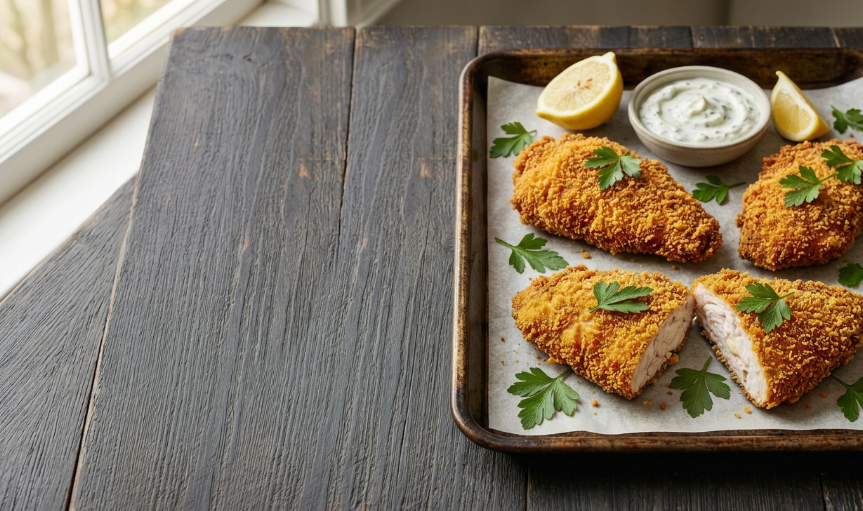
 Simple baked in the oven fowl cutlets, straight out of the tray.
For the cutlets – 2 large boneless, skinless chicken breasts (about 700 g total) — or 4 turkey cutlets – 1 tsp fine salt – ½ tsp black pepper – 1 tsp Italian seasoning or dried oregano
For the breading station – 4 tbsp plain flour (optional but it helps the egg grip) – 2 eggs, beaten with a splash of milk – 100 g panko breadcrumbs – 30 g finely grated parmesan – 1 tsp garlic powder – 1 tsp smoked paprika – Salt and pepper
To finish – Oil spray (or 2 tbsp olive oil brushed on) – Fresh parsley, lemon wedges
Substitutions that actually work
- No panko? Standard dried breadcrumbs are fine, but the crust will be denser. Crushed cornflakes give the loudest crunch of all.
- No egg? Melted butter, mayonnaise or even a thin coat of Dijon all bind the crumb. Butter browns fastest, so drop the oven to 190°C / 375°F.
- Gluten-free? Gluten-free panko plus gluten-free flour, and handle gently — the crumb is more fragile before baking.
- Dairy-free? Skip the parmesan, add an extra pinch of salt and a little nutritional yeast for the savoury note.
- Shortcut version: if you only have five minutes, skip the flour and egg entirely. Pat the cutlets dry, brush with oil, press the seasoned crumb on firmly. Slightly less crisp, still very good.
How to Bake Fowl Cutlets — Step by Step
Step 1 — Heat the oven properly. Set it to 200°C / 400°F / gas mark 6 and let it come to temperature fully, at least 15 minutes. An under-heated oven steams the crumb instead of browning it. Line a rimmed baking sheet with parchment. If you own a wire cooling rack, sit it inside the tray — the cutlets lift off the paper, hot air circulates underneath and the bases stay crisp.
Step 2 — Flatten the cutlets. Lay each breast flat and slice it horizontally through the middle into two thinner pieces. Cover with cling film and pound with the flat side of a mallet or a heavy pan until evenly 1 cm thick. Even thickness matters more than how thin you go. Pat everything dry with kitchen paper — a wet surface is the number one reason breading slides off.
 Even thickness is the whole game. Flatten under cling film.
Step 3 — Season the meat, not just the crumb. Sprinkle the salt, pepper and oregano over the raw cutlets. Seasoning the breadcrumb alone leaves the chicken itself bland.
Step 4 — Set up three dishes. Flour in one, beaten egg in the second, panko mixed with parmesan, garlic powder and paprika in the third. Keep one hand for wet and one for dry — it stops your fingers turning into a crumb magnet.
 Flour, egg, then panko-parmesan. Dry hand, wet hand.
Step 5 — Dredge in order. Flour, shake off the excess. Egg, let it drip. Then press firmly into the panko, patting so the crumb sticks all over. Press harder than feels necessary; loose crumbs fall off in the oven.
Step 6 — Arrange and spray. Lay the breaded cutlets on the rack or parchment in a single layer with a little space between them. Crowding steams them. Spray the tops evenly with oil, or brush lightly with olive oil — this is the step that turns pale crumbs into a golden crust, so do not skip it.
 A wire rack lets the hot air under the crumb. That is the crispness trick.
Step 7 — Bake, then flip. Bake for 10 minutes, then flip each cutlet with tongs and continue for another 5–10 minutes until deep golden and the centre reads 74°C / 165°F.
Step 8 — Rest briefly. Move them to a board and wait 3–4 minutes. The juices settle and you lose far less when you cut in.
Kitchen note: if your cutlets look golden but the centre is under, cover loosely with foil and give them 3 more minutes. If they are cooked but pale, flash them under the grill for 45–60 seconds.
How Long to Bake Chicken Cutlets at 400°F
 74°C / 165°F, then rest. Look at that interior.
The honest answer: 15–20 minutes for a 1 cm thick cutlet at 200°C / 400°F, flipped once halfway. Thin cutlets need only 10–15 minutes, and anything over 2 cm takes 20–25. Always confirm with a thermometer rather than the clock — oven temperatures drift, and a fan oven runs hotter than the dial suggests.
| Oven temperature | 0.5 cm | 1 cm | 2 cm |
|---|---|---|---|
| 180°C / 350°F / gas 4 | 15–18 min | 22–26 min | 28–32 min |
| 190°C / 375°F / gas 5 | 12–15 min | 20–24 min | 25–28 min |
| 200°C / 400°F / gas 6 | 10–15 min | 15–20 min | 20–25 min |
| 220°C / 425°F / gas 7 | 8–12 min | 12–16 min | 18–20 min |
Fan ovens: drop 20°C from the dial setting. A 200°C conventional oven is roughly 180°C on a fan setting.
Four Variations Worth Knowing
Crispy breaded (the recipe above). The classic. Best all-rounder, best for freezing.
No-breaded “naked” cutlets. Skip the crumb entirely: olive oil, salt, pepper, smoked paprika, then bake at 220°C / 425°F for 15–18 minutes. Higher heat because there is no crumb to insulate the meat. This is the one to pick if you are eating lighter or serving them sliced over salad and you do not want crumbs in the leaves.
Air fryer version. 195°C / 390°F for 8–10 minutes in a single layer, no flipping needed for thin cutlets. Excellent for two people; useless for six because of the batch size.
Cutlet parm. Bake the breaded cutlets as above, then top each with a spoon of passata and torn mozzarella and return to the oven for 4–5 minutes until the cheese bubbles. A Sunday-night version of the same base recipe.
Troubleshooting: Soggy, Dry or Pale Cutlets
The breading slides off. The cutlet was wet, or you skipped the flour. Dry the meat thoroughly and use the flour-egg-crumb order. Press the crumb in with the heel of your hand.
The bottom is soggy. Use a wire rack, preheat the tray for a couple of minutes before laying the cutlets on it, and never stack them or let them touch.
They came out dry. Probably overshot the temperature. Pull them at 70°C / 158°F and rest for five minutes — carryover cooking will take them past 74°C while they sit, and they stay noticeably juicier.
They are cooked but pale. Your oven ran cool, or you used too little oil. Spray the tops again lightly and finish under the grill, watching closely because panko scorches fast.
One is done before the other. Uneven pounding. Flatten to a consistent thickness, and swap the tray front-to-back halfway through if your oven has a hot spot.
What to Serve With Fowl Cutlets
Keep it simple, because the cutlets are already the work:
- Roasted broccoli with lemon and chilli flakes — 18 minutes in the same oven at the same temperature
- Creamy mashed potato, or crushed new potatoes with butter and parsley
- Lemon-butter orzo, or plain rice with a squeeze of lemon
- Rocket and parmesan salad with a sharp vinaigrette
- Garlic yogurt dip with dill, and a wedge of lemon on the side
- Slaw or pickles if you are serving them in a bun
- Chips or fries, obviously, on a Friday
For a lighter plate, slice the cutlets and lay them over a warm grain bowl with cucumber, tomato and tahini dressing.
Storage, Reheating and Freezing
 Twenty-five minutes, one pan, dinner sorted.
Fridge. Cooked cutlets keep 3–4 days in an airtight container, layered with parchment so they do not stick.
Reheating. Oven at 180°C / 350°F on a wire rack with a splash of chicken stock in the tray beneath — about 10 minutes. The steam keeps them moist and the rack keeps the base crisp. A microwave works but turns the crumb soft; if you must, use 50% power for 60–90 seconds.
Freezing raw, breaded. This is the best make-ahead trick in this recipe. Bread the cutlets, freeze them flat on a tray for an hour, then bag them. They keep three months. Bake from frozen at 200°C / 400°F for 22–26 minutes, no defrosting.
Freezing cooked. Cool completely, wrap individually, freeze up to two months. Reheat from frozen at 180°C / 350°F for 15–18 minutes.
Meal prep. Slice cooled cutlets into strips and portion with rice, roasted veg and a sauce pot. They reheat in a lunchbox far better than a whole breast because they are thin.
Are Baked Fowl Cutlets Healthy?
Compared with fried, yes — and noticeably so. Frying a breaded cutlet can pull in 30–60 ml of oil per portion. Baking uses a light spray, so you save roughly 200–300 calories a serving with no real loss of crunch.
A 150 g chicken cutlet with a panko-parmesan crumb lands around 330–380 kcal, 38–42 g of protein, 12–15 g of fat and 15–18 g of carbohydrate. Turkey cutlets run slightly leaner. Using a keto or gluten-free crumb and skipping the flour drops the carbs to single figures.
Two caveats worth stating plainly. Panko is still white bread, so “baked” does not mean “low carb”. And parmesan and seasoning carry salt — if you are watching sodium, halve the cheese and season the crumb lightly instead. Nutrition figures here are estimates, not medical advice.
Frequently Asked Questions
How long do you bake chicken cutlets at 400°F? For a 1 cm thick cutlet, 15–20 minutes at 200°C / 400°F, flipping once at the halfway mark. Thin 0.5 cm cutlets take 10–15 minutes; thick 2 cm cutlets take 20–25. Always check the internal temperature reaches 74°C / 165°F.
Do I need to flip the cutlets halfway? For breaded cutlets, yes. Flipping at around 10 minutes browns the underside and stops the base going soggy on the parchment. Un-breaded thin cutlets will survive without flipping, but a turn still gives a better colour.
Do I have to pound the chicken before baking? You do not have to, but it is the single biggest improvement you can make. Pounding to an even thickness means the thin edges do not dry out before the thick centre is safe. Alternatively, buy pre-sliced thin breast fillets and skip the mallet.
Can I make baked cutlets without breading? Yes. Brush with olive oil, season generously, and bake at 220°C / 425°F for 15–18 minutes. Use a higher temperature than the breaded version because there is no crumb to protect the surface.
Can I use turkey cutlets instead of chicken? Absolutely, and they work beautifully. Turkey cutlets are larger and leaner, so allow 18–22 minutes at 200°C / 400°F and be careful not to overcook them — they dry out faster than chicken. Duck breasts work too: score the skin, sear skin-side down for 3 minutes, then bake at 220°C / 425°F.
Can I bake them straight from frozen? If you froze them breaded and raw, yes. Bake from frozen at 200°C / 400°F for 22–26 minutes, checking at 22. Do not defrost first — the crumb stays crisper when it goes in cold.
Why is my breading soggy? Three usual suspects: wet chicken, no flour layer, or a crowded tray. Dry the meat, use flour before egg, leave space between the cutlets and use a wire rack so steam escapes from underneath.
Can I make these in an air fryer? Yes — 195°C / 390°F for 8–10 minutes in a single layer. That is the fastest route for a two-person dinner. For four or more people the oven wins simply because of the basket size.
Are baked cutlets actually healthier than fried? Yes, mainly on fat and calories. Baking adds only a spray of oil rather than a deep-fry absorption, saving roughly 200–300 calories per portion. The breadcrumb itself is still a refined carbohydrate, so it is not a low-carb dish unless you swap the crumb.
Can I prepare them the night before? Bread them fully, lay in a single layer on a tray, cover and refrigerate overnight. The crumb softens a little, so bake for the longer end of the range and give the tops a fresh spray of oil before they go in.
The Verdict
This is the sort of recipe that quietly earns a permanent spot in the week’s rotation. It is fast enough for a Tuesday, good enough for guests, forgiving enough that a beginner will get it right first time — and the same method covers whatever bird you happen to have brought home.
If you cook one thing from Husband Can Cook this week, make it these simple baked in the oven fowl cutlets. Cook a double batch while you are at it and freeze half; future you, at 6pm on a Wednesday, will be very grateful.
If you make them, come back and tell me how they turned out — especially if you tried the turkey or duck version. And if you are looking for more straightforward, no-faff dinners, the recipe index has plenty more.
More Simple Dinners from Husband Can Cook
If these cutlets earned a spot in your week, these are the recipes that usually follow them in ours:
- Turkey Cutlets in the Oven — the same method, leaner bird
- Air Fryer Chicken Cutlets — ready in ten minutes flat
- Baked Chicken Cutlet Parm — passata and mozzarella on top
- How to Slice and Pound Chicken Breasts — the knife work, step by step
About Husband Can Cook
Husband Can Cook is a plain-spoken recipe site for anyone who wants a decent dinner on the table without a culinary degree, a mountain of washing up or a shopping list full of things you will use once. It started the way most useful things do: a husband who could barely boil an egg, a hungry household, and a decision to learn to cook properly rather than order in again.
Everything here is cooked at home before it is published. Nothing goes up because it looks good in a photo — if a recipe is fussy, unreliable or just not worth the effort, it does not make the site. You will find honest timings, temperatures in both °C and °F, weights in grams and ounces, and notes on where things commonly go wrong, because that is the part most recipes leave out.
The idea behind husbandcancook.com is simple: if I can cook it, so can you. There is no assumed knowledge, no “season to taste” hand-waving and no twelve-piece equipment list for a Tuesday night dinner. Just food that works, explained the way someone would explain it across the kitchen counter.
If you landed here searching for husband can cook recipes — or you typed husbandcancook straight into the address bar — welcome. Start with the full recipe index, or follow along on Instagram and Pinterest at @husbandcancook for the things we are cooking this week.
Cooked this one? Tell me how it went in the comments, especially if you went off-piste with turkey or duck. And if you want the next simple dinner in your inbox, the newsletter sends one recipe a week — no spam, no life story, just dinner.
Nutrition (per serving, estimate): 355 kcal · 40 g protein · 14 g fat · 17 g carbs · 1 g fibre · 480 mg sodium Allergens: gluten (panko/flour), egg, milk (parmesan) Equipment: rimmed baking sheet · wire cooling rack · cling film · meat mallet or heavy pan · instant-read thermometer · three shallow dishes
- Timing section → FSA guidance on cooking poultry safely and the US safe minimum internal temperature chart. This supports the 74°C/165°F claim and is the kind of citation Google’s quality raters look for on food content.
- Storage section → FSA leftovers guidance, plus an explicit food-safety note.